Close
You have no items in your shopping cart.
Search
RSS

Blog

What You Need to Know Before you Coyote Swap Your Engine

Coyote engines are rising in popularity among the DIY community for off-roaders and speed demons alike. The 5.0L powerplant is a factory option for several Ford vehicles such as the Mustang GT and F-150 — and it can be swapped into many other rides. Read on to learn more about what you should know before swapping a Coyote engine.

What Is a Coyote Engine?

The Coyote is a 5.0L version of the Ford Modular small block V8 engine. It was first released for the 2011 model year and is named after the Ford Motor Company’s first four-valve V8 race car, which A.J. Foyt drove to a pair of Indy 500 victories and 25 wins overall. Designed to compete directly with the 6.2L LS3 (GM) and 5.4L Hemi ESF (Chrysler), the Coyote has an 11:1 compression ratio and port fuel injection that produces 412-460 horsepower stock — yet it can run on 87-octane pump gas.

There are multiple reasons you might swap a Coyote engine into your vehicle rather than the popular LS motor. Since the Coyote has more moving parts, it can rev to and maintain higher RPMs, giving you more power and torque. Ford Modular 5.0L engines also can easily be modified to crank the horsepower even higher.

Coyote Engine Swap Tips

You should consider several factors before proceeding with this swap. The Coyote is much larger than the LS engine because it has dual overhead cams. Because of this, the Coyote will not fit in some smaller vehicles without modifications, and you’ll need to assess the available space. The extra moving parts also can make installations more challenging since more things need to fit together.

In addition, switching to a Coyote engine may require replacing or altering other parts, including:

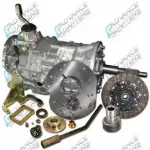
  •          Transmission — Many stock transmissions, especially on older and smaller vehicles, are not strong enough for the Coyote’s torque and need to be swapped for an aftermarket transmission.
  •          Exhaust System — Coyote engines have tubular headers that may not fit your pipes. This will require adding adapters or getting K-members and crossmembers for proper exhaust routing.
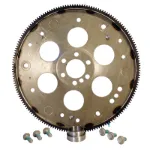
  •          Clutch and Flywheel — If you’re pairing a Coyote with a manual transmission, you should also replace the clutch and flywheel to make sure they’re rated for the power output.
  •          Oil and Filter —The standard Coyote oil filter is on the driver’s side at roughly a 45-degree angle, and the rear sump is too low for some older chassis, both of which must be accounted for.
  •          Cooling — For Coyote engine swaps, you need the coolant fill cap to be the highest point in the system. This can require rearranging the hoses, adding a new supply tank and replacing mechanical fans with electric fans.

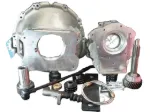
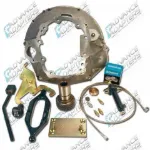
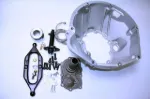
Despite the work and cost involved, many people have found it worth swapping a Coyote engine for their off-road SUVs, hot rods and classic muscle cars. Advance Adapters offers an assortment of Coyote engine swap parts such as bellhousing kits to help with your engine project.

What Are the Components of a Transmission

The transmission is a critical component in any on-road or off-road vehicle. The better your transmission works, the more of an engine’s power is translated to performance. Even if a powerplant has 800 horsepower, it won’t matter if those horses can’t reach the wheels.

But there are a lot of moving parts in a transmission, and they all need to work in harmony for your truck or SUV to go. Below, experts have explained what components are in a transmission for both manual and automatic designs. This will give you a better understanding of how a transmission works to help with upgrades and repairs.

Parts of a Manual Transmission

  •          Flywheel — A metal disc made of extremely rigid metal. It’s what connects the engine to the clutch when the latter is engaged and also provides rotational mass.
  •          Clutch — This connects the flywheel to the input shaft. When disengaged, the transmission rotates independently of the engine.
  •          Clutch Pedal — A hydraulic part that is pressed to disengage the clutch.
  •          Input Shaft — What drives the countershaft gears using power supplied by the engine.
  •          Countershaft — Also called the layshaft, it contains an assortment of gears that connect to the output shaft gears and rotate constantly.
  •          Gears — The parts that control the vehicle’s speed and torque. Bigger gears produce more torque while smaller gears have a higher top-end speed.
  •          Output Shaft — The section that connects to the differential so power can be transferred to the wheels.
  •          Selector Fork and Collars — Used to lock a gear in place so torque can be sent to the output shaft.
  •          Dog Clutch — A special clutch permanently connected to the output shaft that engages it with the desired gear.
  •          Synchronizers — A part with frictional plates that slow down gears so they’re running at the same speed as the output shaft and thus can be engaged.

Parts of an Automatic Transmission

  •          Clutch — Like with a manual transmission, the clutch transfers power from the engine. However, the automatic transmission clutch pack has a drum with four discs that are squeezed together by a piston.
  •          Gears — Modern automatic transmissions use a mechanical planetary gear design with a sun gear, planet gears and ring gear that interact to achieve the desired speed and torque.
  •          Bands — Steel rings surrounding the clutch drum that tighten under pressure to stop the drum from turning so the vehicle can shift or stop.
  •          Hydraulic System — Consists of a valve body, transmission fluid, oil pump, seals and gaskets to provide the needed pressure to control the clutch and bands. This is sometimes called the “brains of the transmission.”
  •          Governor and Modulator — These decide when the gears will shift by monitoring the vehicle’s throttle position and speed.
  •          Torque Converter — An “idling clutch” between the engine and gears that disengages the transmission when the vehicle is stopped so the engine doesn’t stall.

Advance Adapters has a large collection of off-road transmissions and components for DIYers. Shop for new transmissions, rebuilt transmissions, shifters, gears and other products to get the power you need.


Frequently Asked Questions


What are the main components inside a manual transmission?

The main components inside a manual transmission include the input shaft, output shaft, countershaft, gears, synchronizers, shift forks, and the clutch assembly. These parts work together to transfer engine power to the wheels while allowing gear changes.

How does the hydraulic system in an automatic transmission work?

The hydraulic system in an automatic transmission uses transmission fluid under pressure to control clutches and bands. This pressure is regulated by a valve body, which directs fluid flow to engage the appropriate gears smoothly without driver input.

What role do synchronizers play in a transmission?

Synchronizers in a transmission help match the speed of the gears being engaged, allowing smooth and noise-free shifting. They prevent gear grinding by synchronizing the rotational speeds before the gears lock together.

Blog archive